Hook sizes
What size hook for catfish
For channel catfish on a spinning setup, start with a 4/0 to 6/0 circle hook. For larger blues and flatheads on baitcasting tackle, step up to 5/0 to 8/0; leave the hook point exposed beside the bait. Smaller channel fish and bullheads can take much smaller J or long-shank hooks, while big blues and flatheads call for larger circles. A circle and a J stamped with the same size can have very different gaps.
Hook size by catfish species
Circle and J hook numbers do not describe the same gap. Larger channel, blue and flathead catfish take larger hooks than bullheads or small channel fish.
Scroll the table sideways to see every column.
| Catfish | Size | Hook | Bait | Where |
|---|---|---|---|---|
| Channel | #2–1/0 J for smaller baits (Georgia); about 3/0 J for cut bait; 4/0–6/0 circle (Minnesota) | J or bait-holder; circle | Worms or cut bait | Ponds, lakes, rivers |
| Blue | 6/0–8/0 anchored; two 8/0 or 12/0 hooks drifting (Missouri) | Circle | Cut shad or skipjack | Big rivers |
| Flathead | 6/0–10/0 (Oklahoma) | Circle | Live sunfish where legal | Rivers and reservoirs |
| Bullhead | #2–1/0 (Iowa) | Long-shank J | Worms | Ponds and small lakes |
Match the hook to the fish, bait and water; the ranges are not interchangeable across hook styles.

Flathead catfish: look at the lower jaw and tail.

Blue catfish: the long anal fin helps distinguish it from a channel catfish.
Hook size by tackle and bait
Use a smaller J hook for a small channel fish or bullhead. No agency publishes a reliable treble size for dip bait or liver, or a hook size for shrimp; fit the hook to the bait instead of treating these circle ranges as treble sizes.
Scroll the table sideways to see every column.
| Tackle | Hook size | Baits | When to choose it |
|---|---|---|---|
| Spinning | 4/0–6/0 Circle hook | Nightcrawler, live minnow, crawfish, large live shiner, cut bait, chicken liver and stink bait or punch bait | Channel-size fish |
| Baitcasting | 5/0–8/0 Circle hook | Nightcrawler, live minnow, crawfish, large live shiner, cut bait, chicken liver and stink bait or punch bait | Step up for blues and flatheads |
Circle, J, Kahle or treble?
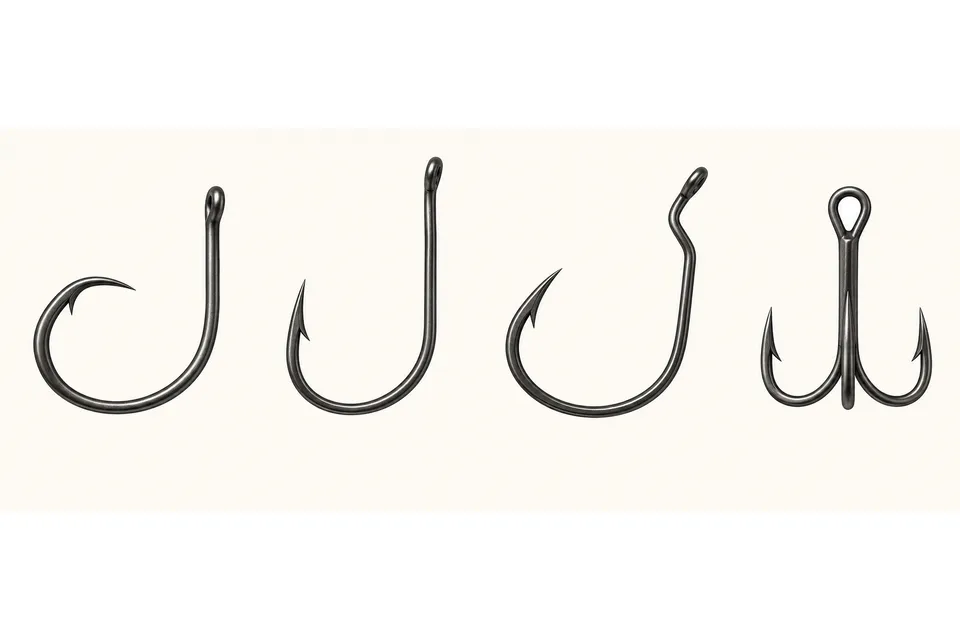
- Left to right: circle, J, Kahle, treble.
How do you set a circle hook?
Let the fish move with the bait, then reel steadily until the rod loads. A hard swing can pull the inward-pointing hook away before it catches the jaw corner. Circle hooks are designed to reduce deep hooking, though they cannot eliminate it.
When does a J or Kahle hook fit?
Use one when you want to set the hook yourself or need the wider open gap around a particular bait. Check the actual gap: the stamped size alone does not tell you how much room the bait leaves.
What about trebles for soft bait?
A treble or bait-holder can keep liver or prepared bait in place. No agency publishes a dependable treble size for dip bait, so use enough gap to leave the points clear.
Why do circle hook sizes run small?
At the same stamped size, Mustad's 39944 inline circle has a narrower gap than its 92553 octopus hook. A 4/0–6/0 circle in this line has roughly the gap of a #2–1/0 octopus. These are one maker's dimensions, not a conversion rule for every hook.
Scroll the table sideways to see every column.
| Stamped size | 39944 inline circle gap | 92553 octopus gap |
|---|---|---|
| 2/0 | 10.4 mm | 16 mm |
| 3/0 | 11.5 mm | 18 mm |
| 4/0 | 12.3 mm | 20 mm |
| 5/0 | 13.7 mm | 22 mm |
| 6/0 | 15.1 mm | 24 mm |
| 7/0 | 16.7 mm | 26 mm |
| 8/0 | 18.4 mm | 28 mm |
| 9/0 | 20.6 mm | 31 mm |
| 10/0 | 23 mm | Not published |
Bars share one 31 mm scale. The 92553 Octopus chart ends at 9/0.
What size sinker for catfish?
Use the lightest sinker that holds the bait where you want it. A pond bullhead rig may need only ¼–½ oz; Minnesota shows a 1 oz egg sinker for channel cats. Missouri's anchored big-river rig uses 3–8 oz, and its drift rig uses 12–24 oz. Current, depth and bait size decide the actual weight. Compare common shapes and weights in the sinker size chart.
How do common catfish rigs go together?
Slip sinker
Thread the sliding sinker above a swivel, then tie on about an 18 in leader and a 6/0–8/0 circle for Missouri's anchored big-river blue-catfish setup. Lighter water calls for less weight.
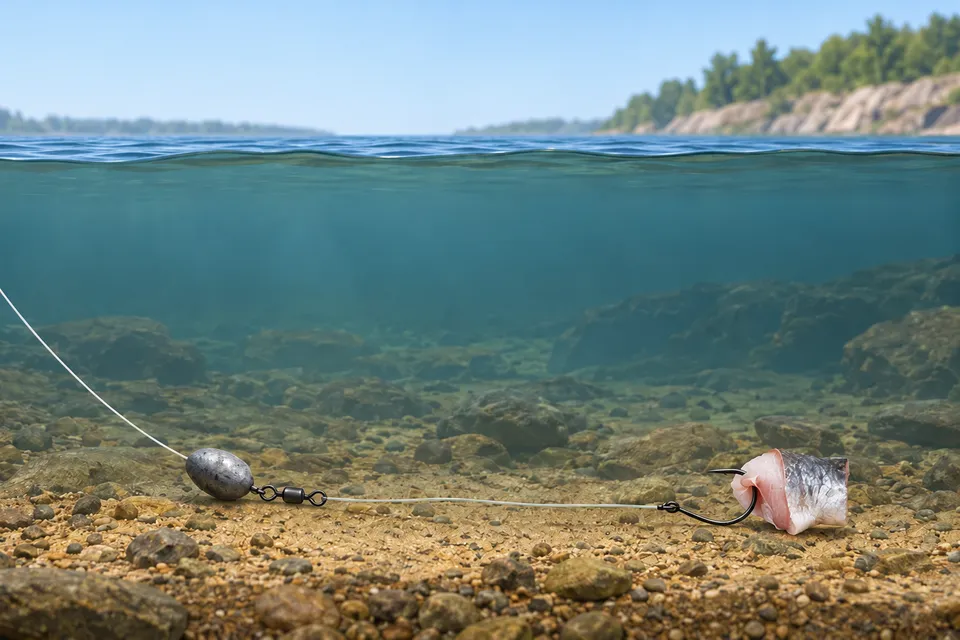
- From rod to bait: sliding 3–8 oz sinker, swivel, about 18 in leader, baited 6/0–8/0 circle.
Two-hook drift rig
Missouri describes two 8/0 or 12/0 circles about 18 in apart on a 30 in leader, with the lower hook about 6 in above a 12–24 oz sinker. Keep the bait moving near the bottom without dragging the hooks into it.
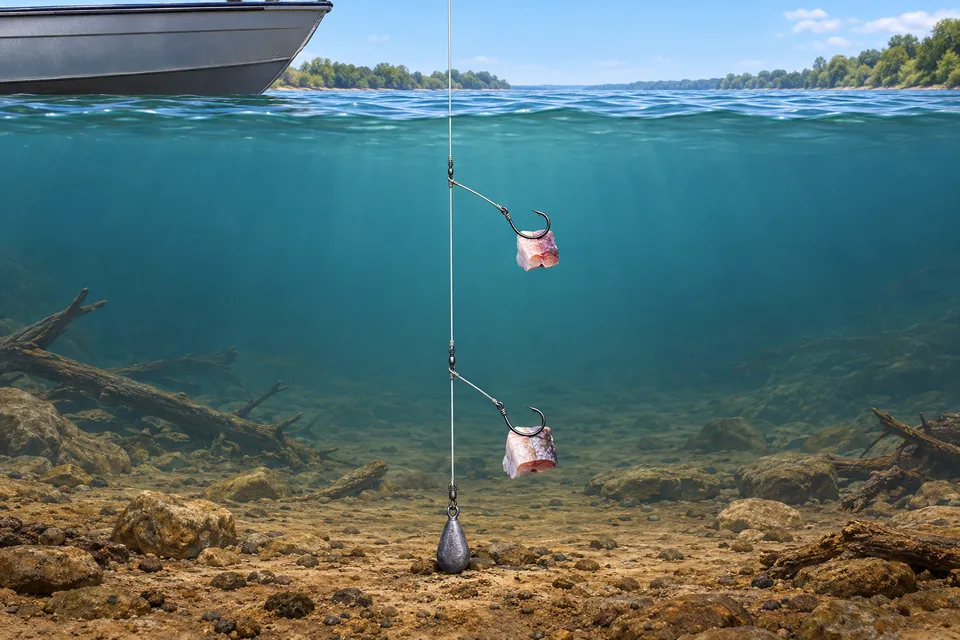
- Two baited 8/0 or 12/0 circles about 18 in apart on a 30 in leader; lower hook about 6 in above a 12–24 oz sinker.
Three-way or float rig
A three-way swivel separates the sinker from the bait when river current would pin a slip rig down. A float keeps bait suspended when fish are off the bottom. Adjust the depth to where fish are holding.
What hook and bait rules apply?
Rules depend on the state, water and device. Missouri's 2026 rules limit most anglers to 33 hooks in the aggregate, with a separate Mississippi River allowance, and require spacing on trotlines. Texas's 2026–27 freshwater rules have a 100-hook limit. Check your current state regulations before setting multiple hooks or using live sunfish as bait.
For your next step, use the Hook Size Finder, the catfish setup guide, the measured hook chart or the sinker chart.