Fishing guide
Ice Fishing Setup by Species
Two rods cover much inland ice fishing: a 20–30 in light panfish rod with 2–4 lb line, and a 32–36 in medium walleye rod. Add a tip-up and a tooth-resistant leader for pike. No ice is completely safe: four inches of new, clear ice is the agency minimum for walking, and thickness must be checked as you go.

A short rod beside an ice hole at Kenai Refuge.
What ice fishing setup works for each species?
These are starting setups, not one rule for every lake. For perch, a short light rod and small jig fall between the sourced panfish and walleye examples; check your rod's line rating.
Scroll the table sideways to see every column.
| Fish | Rod and reel | Line | Lure, hook and bait |
|---|---|---|---|
| Bluegill / sunfish | 20–30 in light or ultralight; 500 spinning | 2–4 lb mono or fluorocarbon | Small ice jig; #12 example with waxworms or spikes |
| Crappie | 28–32 in medium-light, fast; 500–750 spinning | 2–4 lb mono or fluorocarbon; or thin braid with 6 lb fluorocarbon leader | Small jig or spoon; small minnow. Hook number depends on the jig or bait. |
| Yellow perch | No sourced perch-specific rod-length range; choose a short light rod and small spinning reel | Light line matched to the rod | Small jig or spoon with a small minnow. No source reviewed gives a perch hook-number range. |
| Walleye, jigging | 32–36 in medium, fast; 1000 spinning | 6–8 lb fluorocarbon, or 8–10 lb braid with 10–12 lb fluorocarbon leader | Jigging spoon tipped with a minnow head; use the spoon's own hook |
| Walleye, deadstick / tip-up | 36 in or longer medium-light, moderate deadstick; tip-up has no rod | 4–6 lb fluorocarbon on deadstick; tip-up line with 2–3 ft mono or fluorocarbon leader | #6–#8 circle or double hook; two small split shot 7–8 in above a live minnow |
| Northern pike | Tip-up; or 40–48 in medium-heavy to heavy jigging rod | 45–70 lb braided tip-up line; 2–3 ft wire or fluorocarbon leader | Sucker or shiner under 12 in on a quick-strike rig |
| Lake trout | 42–48 in medium-heavy or heavy; 2000 spinning or baitcaster | 10–20 lb mono or fluorocarbon; or 30 lb braid with 15–20 lb leader | Spoon, tube or airplane jig; bait on a tip-up where permitted. Hook size follows lure or bait. |
Published ranges from agency guides and Outdoor Life; perch rod and reel are an editorial choice between their panfish and walleye ranges.
How do I check the ice first?
Drill or probe frequently, starting at shore. New clear ice is stronger than cloudy white ice; Minnesota says to double its guideline for white ice. Stay off slush. Avoid inlets, outlets, springs, moving water, bridges, pressure ridges, vegetation, bubblers and snow-covered patches that hide thin spots. A thick reading in one place says nothing certain about the next.
Scroll the table sideways to see every column.
| Load | Minnesota | New York | North Dakota | Iowa |
|---|---|---|---|---|
| Stay off | Under 4 in | 2 in or less | 2 in or less | — |
| Walking / fishing | 4 in | 4 in | 4 in | 4 in |
| Snowmobile / ATV | 5–7 in | 5 in | 6 in | — |
| Side-by-side ATV | 7–8 in | — | — | — |
| Car / pickup | 9–12 in (car) | 8–12 in | 8–12 in | — |
| Medium truck | 13–17 in | 12–15 in | 12–15 in | — |
| Heavy truck / wheelhouse | 20 in or more | — | — | — |
These are agency guidelines, not a guarantee. The Minnesota vehicle ranges follow its poster; a dash means that agency did not give a figure on the page checked. Iowa gives a walking figure only.
Michigan and Wisconsin stress testing ice and avoiding hazards but do not give a single statewide load chart in the guidance reviewed here. Ask local officials about current conditions; never infer that a vehicle is safe from one thickness reading.
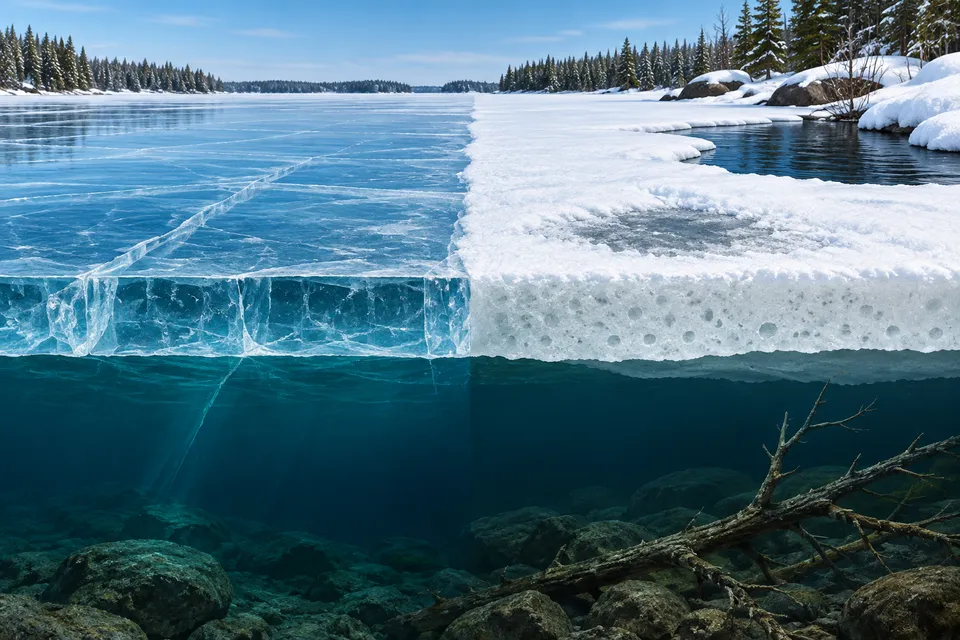
- Left: clear ice
- Right: white ice and open shore
- Below: submerged branch
What should I carry?
Go with a partner. Wear flotation and keep ice picks where you can reach them. Carry a spud or auger to test thickness, a throw rope, whistle, phone in a waterproof case, and traction cleats. Leave your route and return time with someone ashore.
What if I break through?
Turn toward the ice you came from. Put your arms wide on the edge, kick until your body lies flat, and use picks to pull forward. Roll away from the hole rather than standing immediately. Your partner should call for help and throw a rope from solid ice, not rush to the opening.
What about a heated shelter?
Carbon monoxide can build up inside. Use only a heater rated for indoor use, keep a vent near the top and another near the bottom clear of snow, and carry a battery-powered CO detector. Never use an outdoor-style heater inside.
What rod length do I need over a hole?
A short rod reaches down a hole and fits a shelter. The general ice range is 18–36 in; larger pike and lake trout rods can be longer. A jigging rod has a responsive tip for lifting and feeling a lure; a deadstick holds a bait with a softer bend while you watch for a bite.
Spinning or inline reel?
A small spinning reel is a flexible first choice for most fish. An inline reel is useful with tiny jigs because line leaves its spool with less twist than a spinning reel can add. That advantage is less important with heavier spoons, and an inline reel is optional.
What line works in the cold?
Thin mono and fluorocarbon are simple choices for a first panfish rod. Braid has low stretch but can collect water and freeze around guides; a fluorocarbon leader gives a different presentation at the bait. Match the line to the fish and rod, not one winter-wide pound test. Pike tip-ups need heavier line and a 2–3 ft wire or fluorocarbon leader. Compare line diameters and use the Knot Finder for connections.
What jig, spoon or bait should I start with?
For panfish, start with a small ice jig and a waxworm or spike. A small minnow also suits crappie and perch. For walleye, a jigging spoon tipped with a minnow head gives a larger moving target; a live minnow on a deadstick is the quieter option. Check bait collection, transport and use rules for your water.
How much does a tungsten jig head weigh?
The millimeter size describes head diameter, not a fixed weight. These circles and weights are calculated for solid spheres of pure tungsten at 19.3 g/cm³ and lead at 11.35 g/cm³, using volume = πd³/6. Real jig heads have hooks and different shapes or alloys, so read the package for weight and hook size.
Scroll the table sideways to see every column.
| Diameter | To-scale circle | Tungsten | Ounces | Lead, same diameter |
|---|---|---|---|---|
| 2 mm | 0.08 g | 0.003 oz | 0.05 g | |
| 3 mm | 0.27 g | 0.010 oz | 0.16 g | |
| 4 mm | 0.65 g | 0.023 oz | 0.38 g | |
| 5 mm | 1.26 g | 0.045 oz | 0.74 g | |
| 6 mm | 2.18 g | 0.077 oz | 1.28 g |
The circles share a millimeter scale; their sizes and the table come from the same calculation. Ounces use 28.349523125 grams per ounce.
How do I rig a tip-up?
A tip-up's spool hangs below its frame over the hole, and the flag rises when line pays out. For pike, use 45–70 lb braided tip-up line, a swivel, and a 2–3 ft wire or fluorocarbon leader with a sucker or shiner under 12 in. For walleye, Wisconsin shows a 2–3 ft mono or fluorocarbon leader, two small split shot 7–8 in above a #6 or #8 circle or double hook, and a live minnow 4–20 in off bottom depending on clarity. Find the bottom before setting bait depth.
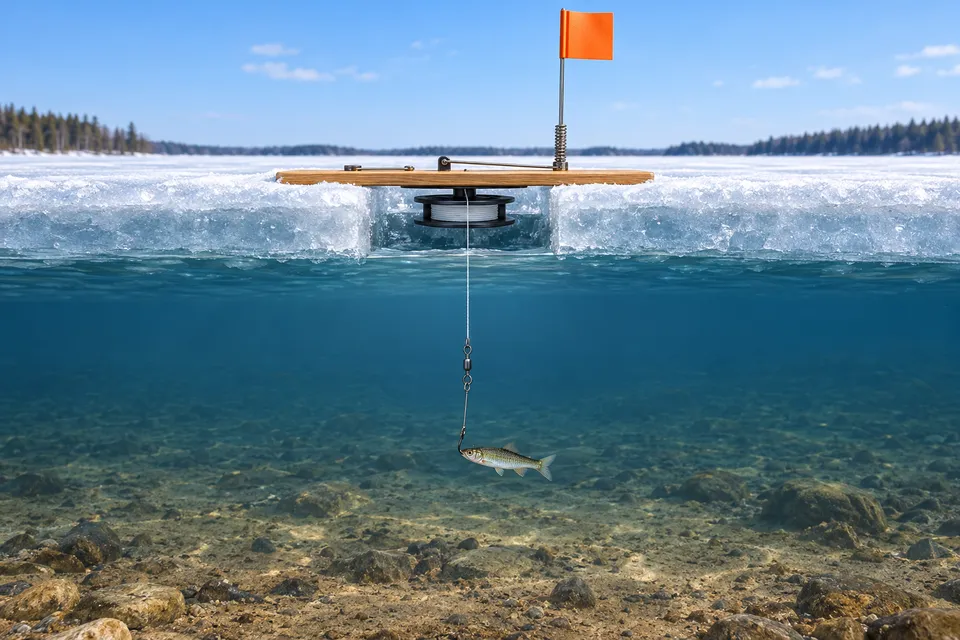
- Frame: wooden crossbar over the hole
- Flag and trip shaft: rise above the frame
- Spool: hangs below the frame in the hole
- Tip-up line: drops from the spool through the water
- Swivel: joins the line to a 2–3 ft leader
- Split shot 7–8 in up: orange dot above the baited hook
- Baited hook: hangs above the lake bottom
What auger and hole do I need?
A hand auger is enough to start. Drill a hole that fits your target fish and gear, and skim loose ice before fishing. Check the current state rules for hole-size limits; no single nationwide limit applies.

A hand auger and short rod make a basic walk-on kit.
What gear can wait?
A sonar unit, shelter, power auger, inline reel, sled and extra tip-ups can wait until you know what you use. Warm layers, dry mittens, wind protection, sturdy boots and traction cleats belong on the first trip. A bucket can carry tackle and give you a seat. If you later heat a shelter, follow the ventilation and detector advice above.

Permanent shanties are an option after you know where and how you fish.
Ice Fishing Setup by Species
What should I pack for my first trip?
tacklechoice.com/ice-fishing/
How many lines or tip-ups can I use?
Check your state and the specific water before setting a second line. Minnesota generally allows two lines through ice, with one on designated trout waters. Michigan enforces a three-line limit including tip-ups. New York allows up to seven ice lines unless special rules apply and requires immediate attendance. Wisconsin describes its general limit as three hooks, baits or lures, rather than a simple line count. Shelter and bait rules also vary; check current regulations before each trip.
What changes from first to late ice?
At first ice, thickness changes quickly and shorelines can be weak. Midwinter fish may respond more slowly, so try a smaller presentation or a bait held still. Late ice can change fast as warmth, runoff and moving water weaken it; keep checking the route back and leave when conditions deteriorate.
Where should I go next?
Use the rod length guide, hook size chart, or the pike guide for a tip-up example. The bluegill, crappie and walleye guides cover each fish beyond the ice season.